

Uncovering Florida Bloodiest Civil War Battlefield: The Dark History of the Battle of Olustee
When most people think of the American Civil War, minds immediately drift to famous battlefields like Gettysburg, Antietam, or Shiloh. However, deep within the pine woods of North Florida lies a heavily shaded landscape holding the memory of a dark, fierce, and incredibly brief conflict.
As local Central Florida Realtors who love exploring the rich tapestry of our state, we recently traveled to Baker County to walk the grounds of Olustee Battlefield Historic State Park. What we uncovered is a powerful chapter of Florida history that every resident and visitor should know.
Why Was the Civil War Fought in Florida?
In early 1864, Florida was largely considered a secondary theater of the war, but it held massive strategic value. The Confederacy relied heavily on the agricultural sector of Florida to feed its troops, particularly through supply lines transporting local beef and salt up north.
Hoping to sever these vital lifelines, recruit escaped slaves into the Union army, and potentially disrupt the regional rail system, Union Brigadier General Truman Seymour landed a force of 5,500 men in Jacksonville. Meeting minimal initial resistance from local militias, Seymour grew confident and pushed his troops deeper into the interior of the state, aiming for the capital city of Tallahassee.
The Fateful Clash at Ocean Pond: February 20, 1864
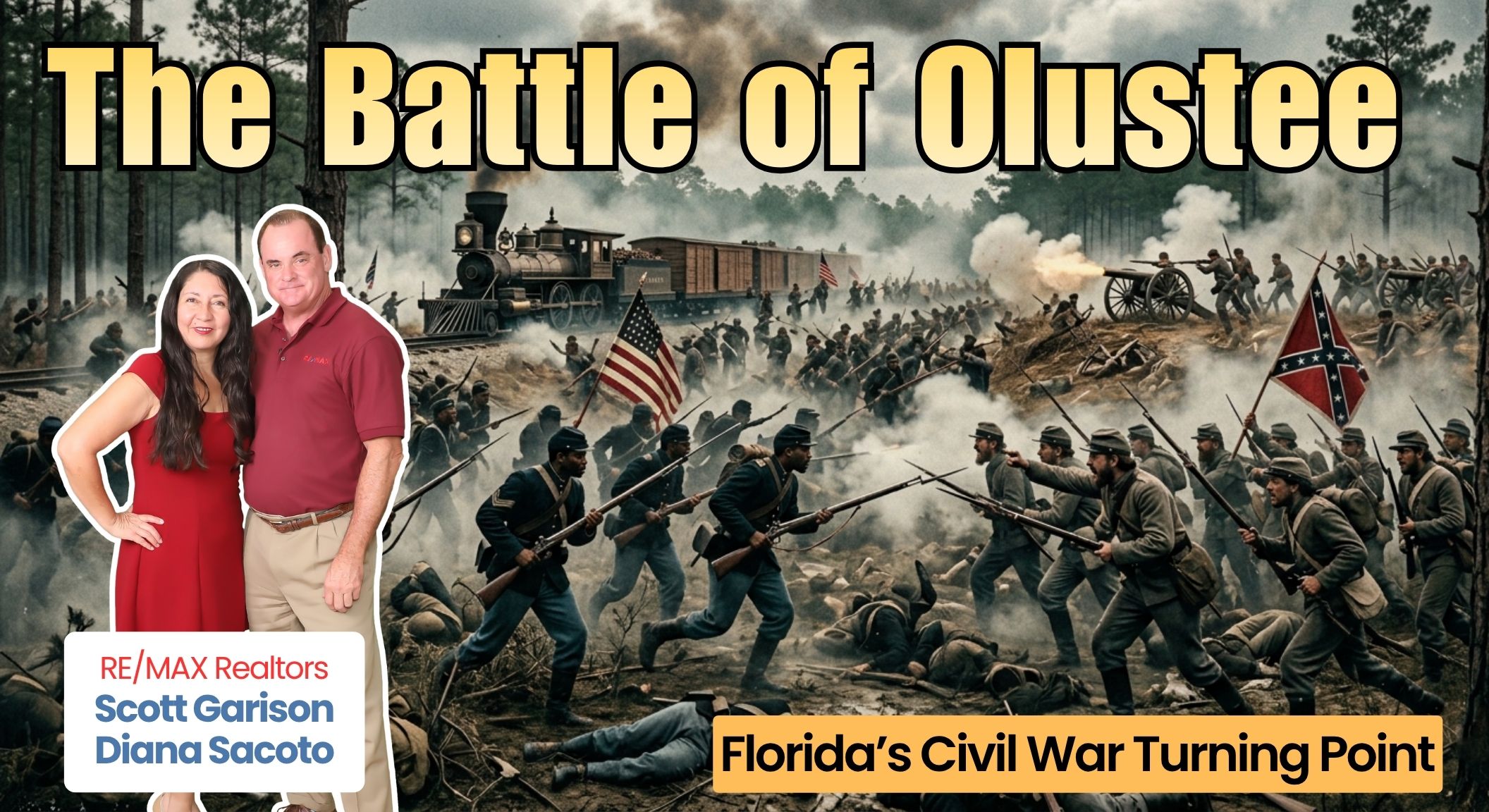
On the morning of February 20, 1864, the Union advance moved steadily west along the Florida, Atlantic, and Gulf Central Railroad line. However, Confederate Brigadier General Joseph Finegan was waiting. Reinforced by troops from Georgia and South Carolina, Finegan entrenched 5,000 men in the open pine forests near Olustee Station, right by a body of water known as Ocean Pond.
What General Seymour assumed would be another easy rout against local militias quickly turned into a tactical nightmare:
Piecemeal Deployment: Believing he faced a small force, Seymour committed his regiments to the field one by one, rather than mounting a unified assault.
The Trapped Zone: The fierce fighting broke out in an area hemmed in between two swamps, leaving the soldiers with little to no physical cover among the tall pine trees.
Running Out of Ammunition: The fighting was so relentless that Confederate forces completely depleted their ammunition, holding their positions entirely by grit until fresh supply trains rolled directly onto the battlefield.
By late afternoon, the Confederate lines advanced as one, shattering the Union position and forcing a full-scale retreat back toward Jacksonville.
The Bravery of the 54th Massachusetts and the USCT
One of the most profound elements of the Battle of Olustee is the role played by African American regiments, who had only recently been permitted to fight following the Emancipation Proclamation.
As the Union lines fractured and panicked troops began fleeing the field, the legendary 54th Massachusetts Volunteer Infantry and the 35th United States Colored Troops were called up to stabilize the rear. Standing steady under devastating fire, these brave soldiers held off the Confederate advance, successfully preventing the total annihilation of the retreating Union army.
In an incredible display of endurance and loyalty following the battle, when a locomotive train carrying wounded Union soldiers broke down on the tracks, men from the 54th Massachusetts literally tied ropes around the train cars and manually pulled their wounded comrades for three miles down the tracks until horses could relieve them.
By the Numbers: One of the Bloodiest Clashes of the War
Though the battle lasted less than six hours, the casualties were staggering. Out of roughly 10,500 total soldiers engaged, nearly 3,000 men were killed, wounded, or captured.
Union Forces under General Seymour
* Total Soldiers Engaged: 5,500
* Total Casualties: 1,861
* Casualty Percentage: Around 34 percent
Confederate Forces under General Finegan
* Total Soldiers Engaged: 5,000
* Total Casualties: 946
* Casualty Percentage: Around 19 percent
In terms of the percentage of casualties relative to the number of troops on the field, Olustee stands as the second bloodiest battle of the entire Civil War for the Union army. The devastating loss fundamentally shocked Northern authorities, causing them to completely abandon further major military expeditions into the interior of Florida for the remainder of the war.
Walking the Historic Trail Today
Today, Olustee Battlefield Historic State Park stands as a beautiful, somber space preserved within the Osceola National Forest. Visitors can walk the interpretive loop trails, view historic stone monuments, and explore the visitor center to read firsthand letters written by the soldiers who stood among these very pines.
Uncovering these stories reminds us that the history of Florida runs incredibly deep. From our coastal forts to these quiet interior battlefields, the communities we live in today were shaped by profound historical events.
Discover More with Your Central Florida Real Estate Experts
Want to explore more hidden gems, local history, and beautiful communities across Florida?
Your trusted Central Florida Realtors, Diana Sacoto and Scott Garrison, love sharing unique histories from across the region. Diana Sacoto specializes in finding the perfect homes for buyers and helping sellers maximize their value in Oviedo, Winter Springs, Orlando North, and throughout Central Florida.
Whether you are looking to buy or sell a home in Oviedo, Winter Springs, Orlando North, or anywhere in the Central Florida region, call the experienced Realtors you already know. Let Scott and Diana help guide your next move with the same deep knowledge they bring to the rich history and vibrant communities of Florida.
This local history spotlight is brought to you by Diana Sacoto, your local RE/MAX Town and Country real estate team. Video production by Sacoto Films Productions.
Join The Discussion